A fragrance oil goes into a clear toner. The batch looks perfect on day one. Two weeks later, the bottles on the shelf have turned hazy, and nobody can say why.
In many cases, the culprit is the solubilizer. The choice between polysorbate 20 vs polysorbate 80 looks minor on a spec sheet, since both are nonionic surfactants from the same chemical family. In practice, the two behave differently with different oils, and picking the wrong one leads to cloudiness, separation or excess surfactant use.
This guide compares the two grades side by side. It covers chemistry, oil compatibility, stability and the quality checks bulk buyers should run before signing a supply contract.
What Polysorbates Are and How They Solubilize
Polysorbates are made by ethoxylating sorbitan and esterifying it with a fatty acid. The ethoxylated part loves water. The fatty acid tail loves oil. That dual nature lets a polysorbate wrap small oil droplets in micelles, so oil disperses into water and the liquid stays clear.
The number in the name refers to the fatty acid used:
• Polysorbate 20 carries lauric acid, a saturated C12 chain.
• Polysorbate 80 carries oleic acid, an unsaturated C18 chain.
Both grades typically have about 20 ethylene oxide units per molecule. So the real difference sits in the tail, and the tail decides which oils each grade handles best.
Solubilizer vs. emulsifier
The same molecule can do both jobs, but the goals differ. A solubilizer creates a clear, single-phase system with very small micelles. An emulsifier creates a stable but usually
opaque dispersion of larger droplets. When clarity matters, as in toners, room sprays or clear cleaners, you need solubilizer performance.
Polysorbate 20 vs Polysorbate 80: Key Differences
The points below summarise how the two grades compare on the points that matter most in formulation and procurement.
• Chemical name: Polysorbate 20 is polyoxyethylene (20) sorbitan monolaurate. Polysorbate 80 is polyoxyethylene (20) sorbitan monooleate.
• Fatty acid tail: Polysorbate 20 carries lauric acid (C12, saturated). Polysorbate 80 carries oleic acid (C18, unsaturated).
• Typical HLB value: about 16.7 for polysorbate 20 and about 15.0 for polysorbate 80 .
• Appearance: Polysorbate 20 is a pale yellow, lower-viscosity liquid. Polysorbate 80 is an amber, more viscous liquid.
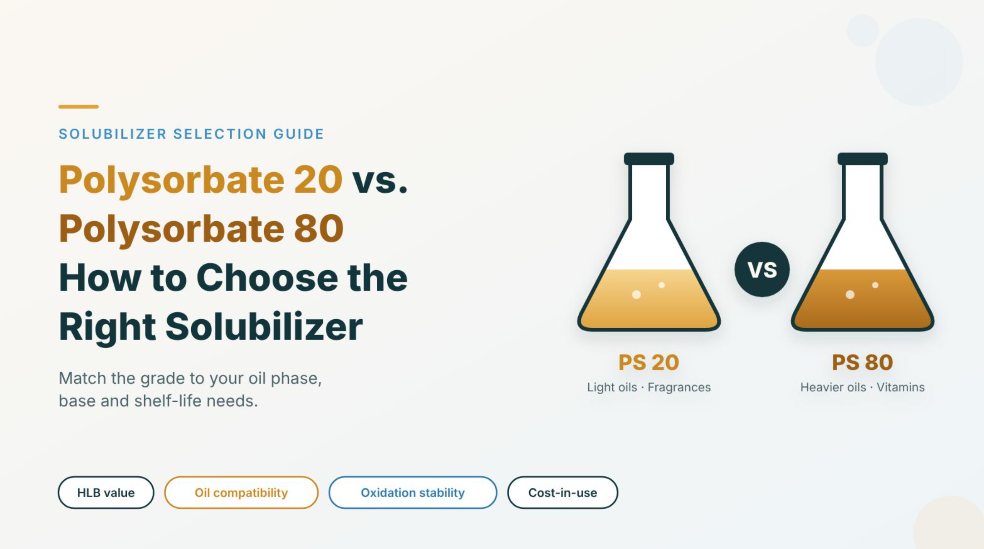
• Best suited to: Polysorbate 20 works best with light oils such as fragrances, essential oils and light botanical extracts. Polysorbate 80 handles heavier oils such as vegetable oils, fat-soluble vitamins and flavour oils.
• Oxidation sensitivity: lower for polysorbate 20 (saturated tail), higher for polysorbate 80 (double bond in tail).
• Odour profile: both are mild; polysorbate 80 can develop off-notes as it ages. • Common uses: Polysorbate 20 appears in toners, mists, room sprays and clear cleaners. Polysorbate 80 appears in bath oils, food emulsions, agrochemical concentrates and textile auxiliaries.
The HLB gap looks small, but it is meaningful. A higher HLB means a more water-loving surfactant, which suits small, volatile oil molecules. The longer C18 tail of polysorbate 80 gives it more room to hold bulky oil molecules in its micelle core.
How to Choose the Right Solubilizer
No single grade wins everywhere. Work through these five factors before you lock in a specification.
1. Start with the oil, not the surfactant
The oil phase drives the decision. Small, volatile molecules such as citrus terpenes, floral fragrance compounds and peppermint oil usually clear up faster with polysorbate 20. Larger, heavier molecules such as fixed vegetable oils, vitamin E acetate or flavour oils generally need the longer tail of polysorbate 80.
2. Check the required ratio
Solubilizers are rarely used at a 1:1 ratio with oil. Many clear systems need several parts surfactant for each part oil. A useful bench method is a ladder test: hold the oil constant and step up the surfactant until the mix turns clear at your storage temperature. The grade that reaches clarity at the lower ratio usually wins on cost and skin feel.
3. Consider the full formula
Alcohol, glycols and salts all shift solubility. Ethanol often helps clarity. High electrolyte levels can push nonionic surfactants towards their cloud point and cause haze. Always test in the final base, not in water alone.
4. Think about stability over shelf life
Polysorbate 80’s unsaturated tail makes it more prone to oxidation. In products exposed to air, light or heat, that can mean odour drift and peroxide build-up. Antioxidants, nitrogen blanketing and opaque packaging help. Polysorbate 20 is more forgiving here.
5. Match the grade to the end market
Food, personal care and industrial grades are often sold under different specifications. Check which regulatory listings your market needs before you choose a supplier.
Quick selection guide
• Fragrance or essential oil in a clear aqueous product: start trials with polysorbate 20.
• Vegetable or carrier oil: start trials with polysorbate 80.
• Fat-soluble vitamins or flavour oils: start trials with polysorbate 80. • Mixed light and heavy oils: try a blend of both, tuned by ladder test.
Bulk Sourcing Checklist for Polysorbates
When you buy by the drum or tanker, small specification gaps turn into large batch problems. Ask for these on every Certificate of Analysis (CoA) and supplier qualification pack:
• Acid value and saponification value within your agreed range
• Hydroxyl value, to confirm the degree of ethoxylation
• Water content (Karl Fischer), since moisture speeds hydrolysis
• Peroxide value, especially for polysorbate 80
• Colour (Gardner or APHA) and odour against a retained standard
• Residual ethylene oxide and 1,4-dioxane limits, as required by your market • Grade declaration: food, cosmetic or technical
• Packaging details: lined drums or IBCs, nitrogen headspace, shelf life • Lot-to-lot consistency data from at least three recent batches
Common Mistakes and How to Avoid Them
Choosing by price per kilo alone. The cheaper grade may need twice the dosage to reach clarity. Compare cost per finished litre instead.
Testing only at room temperature. A clear sample at 25°C can cloud at 5°C or 45°C. Run freeze-thaw and heat cycles before approval.
Ignoring storage conditions. Polysorbates absorb moisture and oxidise in half-empty drums. Reseal promptly, keep away from heat and use stock on a first-in, first-out basis.
Switching suppliers without re-testing. Two products with the same name can differ in fatty acid distribution and impurity profile. Treat any supplier change as a formulation change.
See also: Fly Business Class to India on a Budget: Secrets Airlines Don’t Tell You
Frequently Asked Questions
What is the main difference between polysorbate 20 and polysorbate 80?
The difference lies in the fatty acid. Polysorbate 20 uses lauric acid, a short saturated chain, and has a higher HLB. Polysorbate 80 uses oleic acid, a longer unsaturated chain,
and has a slightly lower HLB. As a result, polysorbate 20 suits light oils, while polysorbate 80 handles heavier oils better.
Which polysorbate is better for essential oils?
Polysorbate 20 is usually the first choice for essential oils and fragrances in clear water based products. Its higher HLB and shorter tail match small, volatile oil molecules. Heavier essential oils or blends with carrier oils may need polysorbate 80 or a mix of both, confirmed through a ladder test.
How much polysorbate do I need to solubilize an oil?
There is no fixed ratio. Light fragrances may clear at a few parts surfactant per part oil, while heavier oils need more. The reliable approach is a ladder test: keep the oil constant, raise the surfactant step by step, and note the lowest ratio that stays clear across your storage temperature range.
Can polysorbate 20 and polysorbate 80 be used together?
Yes. Blending the two is common when an oil phase contains both light and heavy components. The blend gives an intermediate HLB and can reach clarity at a lower total surfactant level than either grade alone. Test different blend ratios in the final formula before scaling up.
Why does my polysorbate solution turn cloudy over time?
Cloudiness usually points to too little solubilizer, temperature swings near the cloud point, high salt levels, or surfactant degradation. Oxidation and hydrolysis, more common in polysorbate 80 stored poorly, reduce performance. Check the ratio, storage conditions and peroxide value of the raw material.
Conclusion: Let the Oil Make the Call
The polysorbate 20 vs polysorbate 80 decision is less about which grade is better and more about which one fits your oil phase, your base and your shelf-life demands. Polysorbate 20 tends to win with light fragrances and clear aqueous products. Polysorbate 80 earns its place with heavier oils, provided you manage oxidation.
Before your next purchase order, run one ladder test with both grades in your actual formula. Compare the dosage each needs to reach stable clarity, then convert that into cost per finished litre. That single exercise often tells you more than any datasheet.